Phoenix Packaging - Factory Automation
Supplier emails into the ERP, automatically - with a live factory dashboard.
The brief
Phoenix Packaging make corrugated cartons in Berkeley Vale. Like a lot of manufacturers, their mornings started with a ritual: two suppliers email through work-in-progress spreadsheets, and someone re-keys every line into the ERP before the floor can trust the job board. Same data, typed twice, five days a week. We built a system that does the typing - and then kept going, because once the data flows automatically you can put it on a screen the whole factory watches.
The challenge
The supplier reports arrive as HTML tables inside emails, at different times, in different formats, referencing purchase orders that have to be matched to jobs living in two separate systems. Getting a date wrong on a factory job board has real consequences, so 'mostly right' wasn't acceptable - and neither was a black box the team couldn't check. The system had to earn trust before it earned write access.
What I built
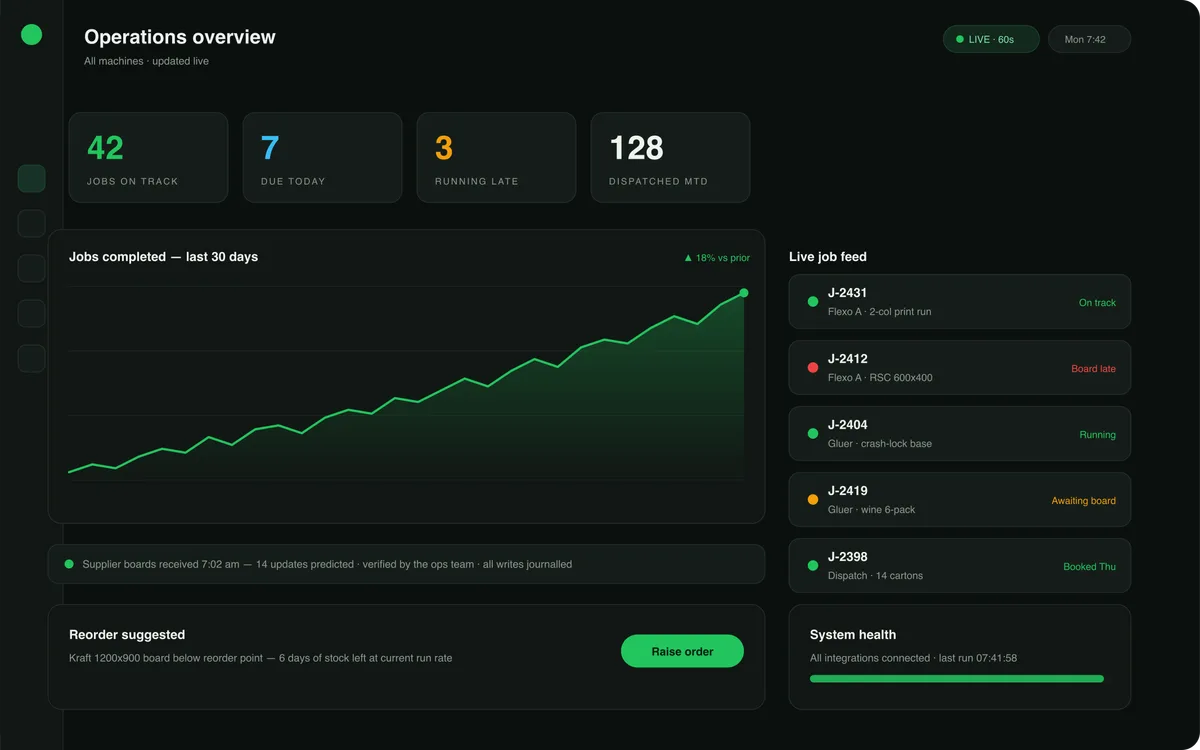
We built the pipeline to be verifiable at every step. It polls the inbox, parses and classifies each supplier's report, matches order lines to jobs, and - before anything is written - emails the ops team a side-by-side prediction of exactly what it would change, so a human verifies instead of types. Every automated write is journalled with its before-state and is fully reversible, and new write paths run in shadow mode until they've proven themselves. The live dashboard polls the job systems and shows every job as a traffic light grouped by machine - wallboard for the factory TV, per-station views for the floor, a one-click stock reorder board for the office. It runs in Phoenix's own Azure account in Sydney, so they own the infrastructure and the data stays in Australia.
The outcome
On its first live morning the system's predictions matched the admin's manual entries 14 for 14. It now runs every weekday morning unattended, backed by 627 automated tests across 33 production releases, and the whole platform costs the client roughly $40 a month in cloud to operate. The morning re-keying ritual is gone, and the factory floor has a live board it can trust.
We used to start every morning re-keying supplier spreadsheets before anyone could trust the job board. That's gone. The floor has a live board now, and the numbers are right. Everything looks amazing.
Phoenix Packaging - Factory Automation
Supplier emails into the ERP, automatically - with a live factory dashboard.
Visit live site (opens in a new tab)